This is the index for every complete-machine build guide on the site, grouped by the job the machine does. Each one is a tested tutorial, not a parts list scraped off a spec sheet: a real parts table, the reasoning behind every choice for that specific workload, the assembly gotchas that actually bite, and benchmarks run on the job the box is built for.
These homelab PC build guides consolidate the component reviews into purchase-ready machines for a handful of jobs: a Proxmox virtualization host, a local AI and LLM workstation, a storage server, a distributed storage cluster, and a developer or Kubernetes box. Under each build sit the decision guides that answer the questions builders hit first, whether you need ECC, whether AMD or Intel fits your workload, and how PCIe lanes get spent. Pick the goal that matches yours below, or read the decision guides first if you are still choosing parts.
This index is kept current as new builds land, and every guide it links was assembled and benchmarked on real hardware, most recently in July 2026.
Start here: which build fits your goal
If you already know what the machine is for, jump straight to it.
| Your goal | Build to follow |
|---|---|
| Run a stack of VMs and containers at home | Proxmox virtualization host |
| Run LLMs locally on your own GPU | Local AI and LLM workstation |
| Store and protect a lot of data (single box) | ZFS storage server with TrueNAS |
| Scale storage across several nodes | Ceph storage cluster |
| Compile, containerize, and run VMs for work | Linux DevOps workstation |
| Learn Kubernetes on real hardware | Three-node Kubernetes home cluster |
Proxmox and virtualization host builds
The virtualization host is where most homelabs start, and it is the build with the deepest testing behind it. The Proxmox homelab server build covers three tiers, from a quiet micro-ATX box to a used-EPYC beast with registered ECC, with real IOMMU-group captures from the lab so you know passthrough will work before you buy. Before you commit to parts, three decisions shape the whole machine: whether the workload justifies ECC memory, whether AMD or Intel suits how you run VMs and transcodes, and how the board’s PCIe lanes get divided between the GPU and your NVMe drives.
Local AI and LLM workstation builds
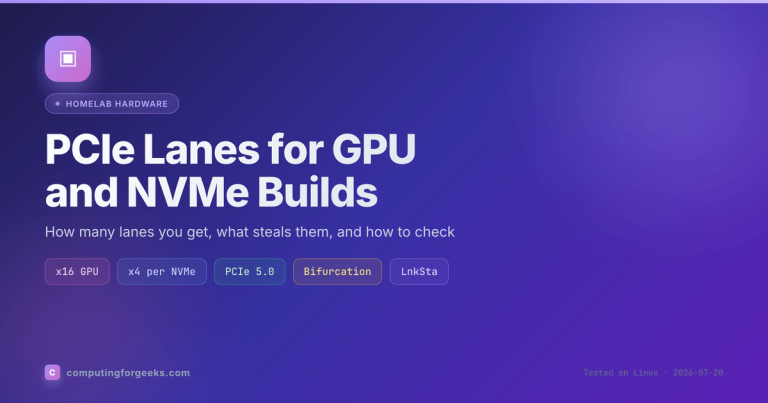
Running a 70B model on your own hardware is a different sizing problem, driven by VRAM rather than cores. The local AI workstation build steps from a single 24GB card up to dual 3090s and a 5090, with tokens-per-second numbers pulled from real inference runs rather than guessed. If you are going multi-GPU, the lane math matters, and a board that splits to x8/x8 is fine for two cards, which the PCIe lanes breakdown explains. For the card itself, the best GPU for local LLMs comparison is the place to start.
NAS and distributed storage builds
Storage splits into two shapes. For most people a single well-built box is the right answer, and the ZFS storage server build walks four to twenty four bays of TrueNAS with real pool and sync-write numbers. When one chassis is not enough and you want storage that survives a whole node failing, the Ceph storage cluster build assembles three matched nodes with dedicated NVMe and a 10GbE Ceph network, tested with real cluster output. Sizing a Ceph cluster has its own rules, covered in the Ceph home lab hardware requirements guide, and if you are weighing a small purpose-built box instead, the home NAS buyer guide covers the turnkey route.
Developer and Kubernetes builds
A workstation for development work earns its keep in cores, RAM, and fast storage rather than a big GPU. The Linux DevOps workstation build spans a lean AM5 box to a Threadripper with 256GB of registered ECC, sized for parallel builds, big container images, and nested VMs. When you want to learn Kubernetes on metal instead of a single node, the three-node Kubernetes home cluster build uses matched mini-PCs or nodes with a proper switch, and it pairs well with the homelab mini PC guide for choosing the nodes.
The decision guides behind every build
Half the questions in a build thread are really about one component, and these guides answer them on their own, no full build required. The ECC RAM guide sorts out which platforms support real error-correcting memory and which “ECC” is just a marketing line. The AMD vs Intel breakdown weighs cores, QuickSync transcoding, IOMMU, and idle power for a homelab specifically. The PCIe lanes guide shows how a desktop CPU’s small lane budget gets spent and how to read what your board negotiated. Read these first when you are still deciding parts, then drop into the build that matches your goal.
How these homelab PC build guides are tested
Every build here is measured, not imagined. The virtualization and storage builds run on a nested Proxmox lab where the IOMMU groups, ZFS sync-write throughput, and Ceph cluster output are captured from real machines. The AI workstation reuses tokens-per-second data from actual inference runs on 3090, 5090, and datacenter cards. Where a specific part could not sit on the bench, the guide says so plainly and labels the figure as vendor spec or independent test rather than dressing a spec sheet up as a benchmark. Prices move constantly, especially through the current memory-price swings, so every build gives price bands and points you at the live listing rather than a number that is stale by the time you read it. That is the whole point of building the machine yourself: you know exactly what is in it and why, and these guides are written so you can defend every choice.