Brave is a Chromium-based browser with the ad-block, tracker-block, fingerprint defenses, and a private search engine bundled in by default. The same Chromium engine that powers Chrome and Edge runs the rendering, so every extension from the Chrome Web Store works, but the default privacy posture is tighter than anything that ships with stock Chrome. Brave Software publishes an official RPM repository for Fedora that integrates cleanly with dnf, so installation is a three-line affair.
This guide installs Brave on Fedora 44, 43, and 42 from the official repository, walks through the first-launch flow with screenshots, covers the Brave Rewards opt-in question every reader will face, and ends with the keep-updated and clean-uninstall paths. Tested on a fresh Fedora 44 with GNOME 50.
Prerequisites
You need a Fedora 44, 43, or 42 desktop with sudo access. Workstation, Spins (KDE, Sway, Cinnamon), and Silverblue all work. Brave is around 430 MiB on disk after install and reaches brave-browser-rpm-release.s3.brave.com for the package files.
Step 1: Install dnf-plugins-core
The Brave install uses dnf config-manager to register the repo. That subcommand lives in the dnf-plugins-core package, which is normally already installed on Workstation but may be missing on Server or Cloud Edition. Install it explicitly to be safe:
sudo dnf install -y dnf-plugins-coreStep 2: Add the Brave RPM repository
Fedora 44 and 43 ship DNF5, which uses config-manager addrepo --from-repofile=:
sudo dnf config-manager addrepo \
  --from-repofile=https://brave-browser-rpm-release.s3.brave.com/brave-browser.repo
On Fedora 42 with DNF4 the flag is --add-repo instead:
sudo dnf config-manager \
  --add-repo https://brave-browser-rpm-release.s3.brave.com/brave-browser.repo
Confirm the repo is registered:
sudo dnf repolist | grep -i braveStep 3: Install Brave
Install the package. On first install, DNF prompts you to import the Brave GPG signing key. Accept it:
sudo dnf install -y brave-browserThe transaction installs the browser and its keyring helper:
Importing OpenPGP key 0x20038257:
 UserID     : "Brave Linux Release (Brave Linux Release) <[email protected]>"
 Fingerprint: DBF1A116C220B8C7164F98230686B78420038257
The key was successfully imported.

Installing:
 brave-browser   x86_64   0:1.90.124-1   brave-browser   428.3 MiB
 brave-keyring   x86_64   0:1.19-1       brave-browser    17.3 KiB

Complete!
Step 4: Verify the install
Check the version and the binary path:
brave-browser --version
which brave-browser
The version string and the binary location both come back:
Brave Browser 148.1.90.124
/usr/bin/brave-browser
Launch Brave from the application menu (under Internet) or directly from a terminal:
brave-browser &Step 5: First launch and the new tab page
On first launch, Brave shows its custom new tab page with the search bar, the shields stats panel, and the rewards prompt. The bottom-right of the page shows Brave Rewards and Brave News onboarding cards you can dismiss if you do not want them.
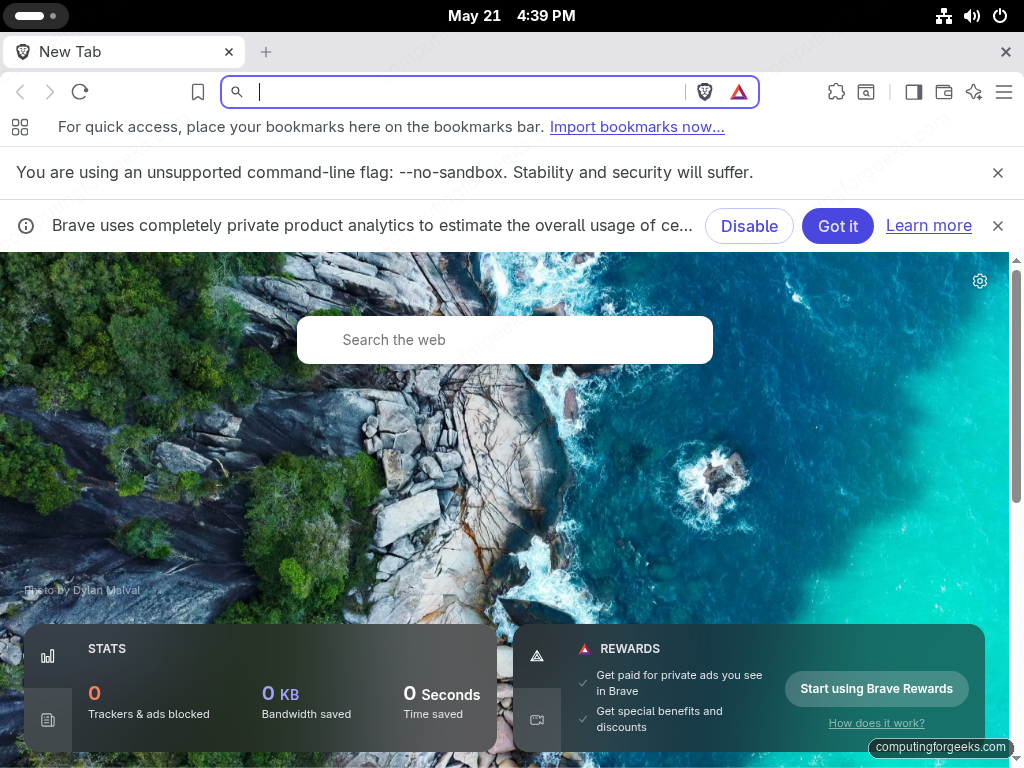
The shields icon to the right of the address bar shows the count of trackers and ads blocked for the current site. Click it to toggle shields off for sites that break with strict blocking. Click the lion icon (top-right) for the rewards opt-in if you want to earn BAT for opting into privacy-preserving ads; click the gear icon to skip rewards entirely.
Step 6: Install Chrome Web Store extensions
Brave reads from the Chrome Web Store directly. Open chrome://extensions in Brave (yes, the URL really starts with chrome://), toggle Developer mode on if you want side-loading, then visit any extension page on the Chrome Web Store and click Add to Brave.
Brave also runs its own catalog of vetted extensions reachable from brave://extensions. The two share the same underlying engine, so an extension installed from either source works the same way.
Step 7: Set Brave as the default browser
On first launch, Brave usually shows a “Set as default” prompt. If you dismissed it, set Brave via the freedesktop helper:
xdg-settings set default-web-browser brave-browser.desktop
xdg-settings get default-web-browser
Or on GNOME and KDE: open Settings, find Default Applications, and pick Brave Web Browser for the Web entry.
Step 8: Keep Brave updated
Brave releases a new stable build roughly every two weeks and the RPM repo follows within a day. Because the repo is in your DNF list now, updates ride along with normal system upgrades:
sudo dnf upgrade -y brave-browserTo check whether an update is available without applying it:
dnf check-update brave-browserBeta and Nightly channels
Brave Software publishes Beta and Nightly builds alongside the stable channel. They install side-by-side with their own profile directories and launchers, so the stable build stays untouched. Pick whichever channel you want to ride:
sudo dnf install -y brave-browser-beta brave-browser-nightlyEach channel ships its own binary: brave-browser-beta, brave-browser-nightly. The stable browser stays at brave-browser.
Alternative: Brave via Flatpak
For a sandboxed install that touches no system libraries, Brave is also on Flathub. If you have not already configured Flathub on Fedora, walk through the Flatpak setup guide first, then:
flatpak install -y flathub com.brave.BrowserThe Flatpak build runs through Flatpak’s portal system. File and download access is mediated by per-folder grants, which adds a click or two for File > Save As but keeps the browser isolated from the host filesystem. For everyday browsing, the RPM build is the smoother experience; the Flatpak is the better choice on Silverblue or any setup where you prefer everything sandboxed.
Uninstall Brave
Remove the package, the repo definition, and the user profile in one pass:
sudo dnf remove -y brave-browser brave-browser-beta brave-browser-nightly brave-keyring
sudo rm -f /etc/yum.repos.d/brave-browser.repo
rm -rf ~/.config/BraveSoftware ~/.cache/BraveSoftware
Skip the last line if you plan to reinstall and want to keep your bookmarks, history, and extensions.
Troubleshooting
Error: GPG check FAILED on first install
The Brave signing key was not imported. Re-import it manually:
sudo rpm --import https://brave-browser-rpm-release.s3.brave.com/brave-core.asc
sudo dnf install -y brave-browser
Authentication required: the login keyring did not get unlocked
On first launch, Brave wants to store its profile passwords in the GNOME Keyring. If GDM auto-login is enabled (common on lab and demo VMs), the keyring’s master password does not get unlocked automatically and this prompt appears. Type your login password and click Unlock. To stop the prompt repeating, set the keyring password to empty: open Passwords and Keys (seahorse), right-click Login, choose Change Password, and leave the new password blank.
Brave window is black on a Wayland session
The Chromium Wayland path occasionally regresses on a major Mesa update. Force the X11 backend as a temporary workaround:
brave-browser --ozone-platform=x11To make it permanent, edit /usr/share/applications/brave-browser.desktop and append the flag to the Exec= line.
DRM-protected video (Netflix, Spotify, Prime Video) refuses to play
Brave needs Widevine, the same DRM library Chrome uses. The first time you visit a protected stream, Brave prompts to download Widevine; accept and reload the page. If the prompt does not appear, install Widevine manually from brave://settings/extensions > Widevine.
Useful Brave URLs and flags
| URL or flag | What it does |
|---|---|
brave://settings | Full settings UI |
brave://flags | Experimental feature toggles |
brave://rewards | Brave Rewards opt-in and earnings |
brave://wallet | Built-in crypto wallet |
brave://gpu | GPU acceleration status |
brave://version | Build info and profile path |
chrome://extensions | Manage installed extensions |
Ctrl+Shift+N | Private (incognito) window |
Ctrl+Shift+P | Private window with Tor (anonymous routing) |
--user-data-dir=/path | Launch with an isolated profile |
--ozone-platform=x11 | Force X11 backend (Wayland workaround) |
For an editor to pair with the browser, install VS Code on Fedora. To compare against other browsers on the same machine, the Google Chrome guide covers the proprietary Chrome RPM install and the Vivaldi guide covers the other major Chromium fork. All three browsers can coexist on the same Fedora install with separate profiles.