

Vivaldi is the heavily-customized Chromium fork run by a small team in Norway, born from the people behind the original Opera browser. It carries every Chromium engine improvement (V8, Blink, the same extension API), pairs them with a UI that exposes vastly more knobs than Chrome (tab tiling, vertical tab tree, customizable workspaces, built-in mail client, calendar, RSS reader, notes), and ships an official Linux RPM for Fedora. Pretty much every preference you can imagine has a toggle.
This guide installs Vivaldi on Fedora 44, 43, and 42 from the official RPM published on the Vivaldi download page, walks through the first-launch setup wizard with a screenshot, covers the proprietary-codec auto-install Vivaldi does for H.264 and AAC, and ends with the keep-updated and uninstall paths.
Prerequisites
A Fedora 44, 43, or 42 desktop with sudo access. Vivaldi is around 440 MiB on disk after install. You need network access to downloads.vivaldi.com for the package and to repo.vivaldi.com if you let the post-install script register the official Vivaldi repo for automatic updates.
Step 1: Set the version variable
Vivaldi releases roughly every 3-4 weeks. Pin the version once so later commands stay in sync. Check the current version on the official Vivaldi download page and export it:
export VIVALDI_VERSION="8.0.4033.26" #https://vivaldi.com/download/
export VIVALDI_RPM="vivaldi-stable-${VIVALDI_VERSION}-1.x86_64.rpm"
Confirm the variables are set:
echo "Version: ${VIVALDI_VERSION}"
echo "RPM:     ${VIVALDI_RPM}"
Step 2: Install Vivaldi from the official RPM
The direct-RPM install is the simplest path. DNF downloads the package, resolves the handful of dependencies (mostly font libs and the Chromium runtime bits), and installs the post-install script that registers the Vivaldi repo for future updates:
sudo dnf install -y "https://downloads.vivaldi.com/stable/${VIVALDI_RPM}"On install completion, the package’s post-script registers /etc/yum.repos.d/vivaldi.repo so future dnf upgrade picks up new releases:
Installing vivaldi-stable-0:8.0.4033.26-1.x86_64  437.5 MiB
'Proprietary media' support is not installed. Attempting to fix this now.
Complete!
The “Proprietary media support” line is Vivaldi grabbing the matching libffmpeg.so that handles H.264 video and AAC audio. Chromium’s open-source build does not ship those codecs by default for patent-licensing reasons; Vivaldi pulls a precompiled blob from its own server on install so streaming sites (YouTube H.264 streams, Apple Music) work out of the install instead of after a manual codec hunt.
Step 3: Verify the install
Confirm the package and the binary path:
rpm -q vivaldi-stable
which vivaldi-stable vivaldi
Vivaldi installs both a vivaldi-stable binary and a vivaldi symlink, so either name launches the same browser:
vivaldi-stable-8.0.4033.26-1.x86_64
/usr/bin/vivaldi-stable
/usr/bin/vivaldi
Launch from the application menu (under Internet) or from a terminal:
vivaldi &Step 4: First launch and the setup wizard
On first launch, Vivaldi runs a multi-step setup wizard. The first page covers accessibility toggles (keyboard-friendly mode for screen readers, etc.) and whether to share anonymous crash reports with Vivaldi for product quality improvement:
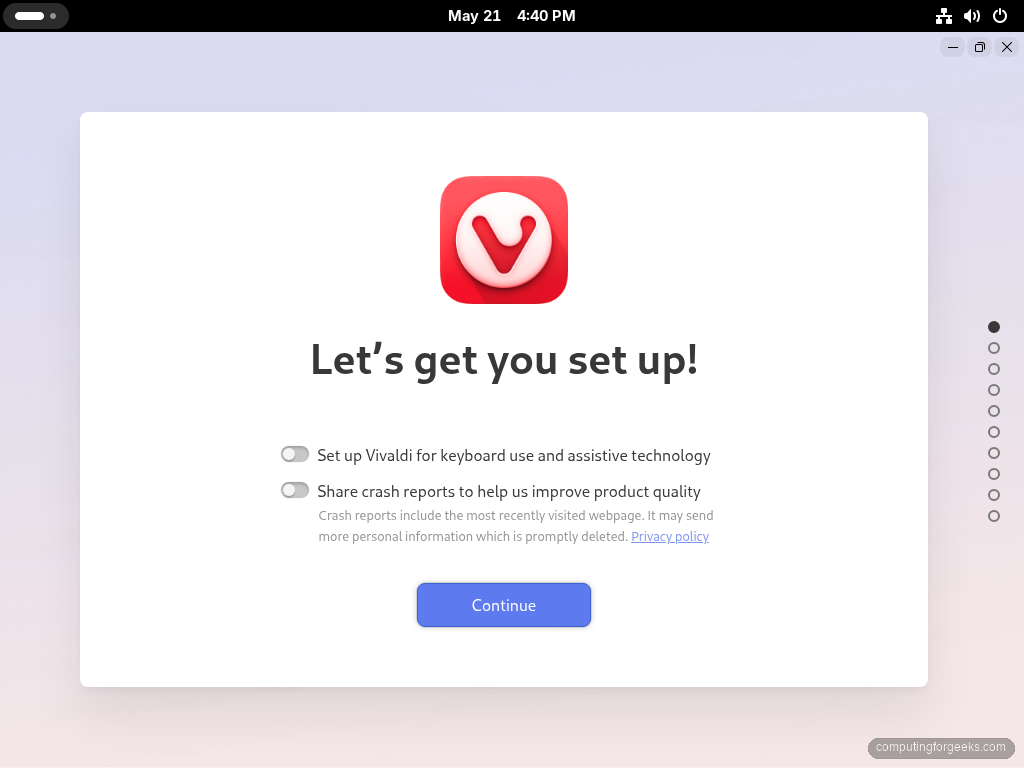
Click Continue to step through the remaining pages: theme (light or dark), tab position (top, bottom, left, right, with Vivaldi being one of the few browsers that supports vertical tab stacks natively), the start page layout, and the import-from-Chrome step that pulls bookmarks and passwords from an existing Chrome profile if you want. Every choice in the wizard can be changed later via vivaldi://settings.
Step 5: Make the most of Vivaldi-specific features
The point of running Vivaldi rather than vanilla Chromium is the extras. The biggest ones worth knowing about on day one:
Tab tiling. Select multiple tabs (Ctrl+click in the tab bar), right-click, choose Tile Tabs. Vivaldi splits the viewport between them so you can edit a doc on the left and reference a page on the right in the same window. No extension needed.
Vertical tab stacks. Settings > Tabs > Tab Bar Position: Left or Right. Useful on widescreen monitors where vertical real estate beats horizontal.
Workspaces. Group related tabs into named workspaces (Work, Personal, Project X). Click the workspace switcher in the tab bar to flip between them; tabs in other workspaces stay loaded but out of sight.
Built-in mail, calendar, and RSS. Enable from Settings > Mail. Vivaldi runs a full IMAP/POP3 mail client inside the browser sidebar. Same for the calendar (CalDAV) and the feed reader (RSS/Atom). For users who want a single window for browsing and personal email, the integrated path replaces Thunderbird-plus-browser-tab.
Notes panel. Sidebar > Notes. Markdown-aware notes with attachment support, indexed and searchable across the browser. Sync across devices via a Vivaldi account (free).
Step 6: Install Chrome Web Store extensions
Vivaldi reads the Chrome Web Store directly. Visit any extension page on chrome.google.com/webstore from Vivaldi and click Add to Vivaldi. The button text changes from “Add to Chrome” automatically thanks to the user-agent string Vivaldi sends.
Manage installed extensions at vivaldi://extensions (or the equivalent chrome://extensions, both URLs work).
Step 7: Set Vivaldi as the default browser
The first-launch wizard offers to set Vivaldi as default. If you skipped that, set it later via the freedesktop helper:
xdg-settings set default-web-browser vivaldi-stable.desktop
xdg-settings get default-web-browser
Or on GNOME/KDE: open Settings > Default Applications and pick Vivaldi for Web.
Step 8: Keep Vivaldi updated
Vivaldi pushes a new stable build every 3-4 weeks. Because the package register a repo at install time, updates flow through normal system upgrades:
sudo dnf upgrade -y vivaldi-stableTo check whether an update is available without applying it:
dnf check-update vivaldi-stableVivaldi also runs its own background updater that nudges you in-browser when a new build lands. Both paths use the same RPM source, so they coexist without conflict.
Snapshot (beta) channel
Vivaldi maintains a Snapshot channel for early-access builds. It installs side-by-side with stable using its own profile directory, so testing Snapshot does not disrupt the stable browser. Grab the current Snapshot RPM from the Linux downloads page (Snapshot tab) and install with:
sudo dnf install -y "https://downloads.vivaldi.com/snapshot/vivaldi-snapshot-X.Y.ZZZZ.AA-1.x86_64.rpm"The Snapshot binary is at /usr/bin/vivaldi-snapshot. Each channel keeps its own user profile under ~/.config/vivaldi-snapshot/ vs ~/.config/vivaldi/.
Uninstall Vivaldi
Remove the package, the repo file, and the user profile in one pass:
sudo dnf remove -y vivaldi-stable vivaldi-snapshot
sudo rm -f /etc/yum.repos.d/vivaldi.repo
rm -rf ~/.config/vivaldi ~/.cache/vivaldi
The last line deletes bookmarks, history, saved passwords, mail account configs, and notes. Skip it if you plan to reinstall.
Troubleshooting
Error: 404 Not Found when downloading the RPM
The version pinned in your variable no longer exists on the Vivaldi mirror (Vivaldi rotates older RPMs out of the stable directory once new releases land). Visit vivaldi.com/download and update VIVALDI_VERSION to the current release.
Proprietary media support failed to install
The post-install script could not reach Vivaldi’s codec server. Re-run it manually:
sudo /opt/vivaldi/update-ffmpeg --userFor full multimedia coverage on the system (Chrome and Firefox benefit too), follow the RPM Fusion codecs guide which installs the unrestricted ffmpeg-libs-freeworld swap.
Vivaldi window is black on a Wayland session
The Chromium Wayland path occasionally regresses on a major Mesa update. Force the X11 backend as a temporary workaround:
vivaldi --ozone-platform=x11To make it permanent, edit /usr/share/applications/vivaldi-stable.desktop and append the flag to the Exec= line.
Hardware video decode (VA-API) is disabled
Open vivaldi://flags, search for VaapiVideoDecoder and set it to Enabled. Restart Vivaldi. Confirm at vivaldi://gpu: Video Decode and Video Encode should both report Hardware accelerated.
Useful Vivaldi URLs and shortcuts
| URL or shortcut | What it does |
|---|---|
vivaldi://settings | Full settings UI |
vivaldi://flags | Experimental feature toggles |
vivaldi://history | Browsing history |
vivaldi://gpu | GPU acceleration status |
vivaldi://version | Build info and profile path |
F2 | Quick Commands (fast keyboard launcher for any action) |
Ctrl+E | Search the address bar |
Ctrl+Shift+N | Private window |
Ctrl+T | New tab |
Ctrl+Shift+T | Reopen last closed tab |
Ctrl+Page Up / Down | Switch tabs |
Alt+E | Toggle full screen |
For other Chromium-family browsers on the same machine: Google Chrome for the proprietary stock Chrome build, Brave for the privacy-first fork with ad-block built in. All three coexist with separate profile directories. Paired with VS Code on Fedora they make a complete browser-plus-editor desktop.


Dropped waivers