What is new in Fedora 44, in one sentence: GNOME 50 retires X11 from the login manager, KDE Plasma 6.6 swaps SDDM for a Plasma-native login flow and a unified setup wizard, the in-tree NTSYNC kernel module makes Windows games feel native, and the developer toolchain is pulled forward another generation (GCC 16.1, glibc 2.43, Ruby 4.0, Go 1.26, PHP 8.5, Helm 4). The release went GA on April 28, 2026 after a two-week slip from the original April 14 target.
If you came in expecting “Fedora 44 ships RPM 6 and DNF5” then you missed the bigger story: Fedora 43 already shipped those. What Fedora 44 does is finish the platform work around them. PackageKit (the abstraction GNOME Software and KDE Discover sit on) is now rebuilt on top of libdnf5. Anaconda only creates network profiles for the device actually used during install. The cert.pem compatibility file is removed in favor of a directory-hash ca-certificates layout. Plasma’s first-boot is a single unified wizard instead of three overlapping ones. None of these are headline features in isolation, but together they are the kind of plumbing release that pays off for the next year of Fedora.
Tested May 2026 on Fedora 44 Cloud (kernel 7.0.8-200.fc44.x86_64), dnf5 5.4.2.0, RPM 6.0.1, GCC 16.1.1, glibc 2.43, Python 3.14.4
This piece breaks down what is new in Fedora 44 with versions pulled from a real Fedora 44 system, not from press-release copy.
What is new in Fedora 44 at a glance
The table is the F43 → F44 delta only. Versions in the F43 column are the GA values published in the Fedora 43 ChangeSet.
| Area | Fedora 43 (GA) | Fedora 44 (GA) |
|---|---|---|
| Release date | October 28, 2025 | April 28, 2026 |
| Kernel at GA | 6.17 | 6.19 (current update train is 7.0.x) |
| Workstation desktop | GNOME 49 | GNOME 50 (X11 removed from GDM) |
| KDE Spin desktop | Plasma 6.4 + SDDM | Plasma 6.6 + Plasma Login Manager |
| PackageKit backend | libdnf (hawkey) | libdnf5 |
| GCC / glibc | 15.2 / 2.42 | 16.1 / 2.43 |
| Ruby | 3.4 | 4.0 |
| Go | 1.25 | 1.26 |
| PHP | 8.4 | 8.5 |
| Helm | 3.x | 4.x (helm3 parallel-installable) |
| LLVM | 21 | 22 |
| Haskell GHC | 9.8 | 9.10 (+ Stackage 24) |
| Boost | 1.89 | 1.90 |
| CMake | 3.31 | 4.x (default generator: ninja) |
| Ansible | 12 | 13 (Core 2.20) |
| MariaDB default | 10.11 | 11.8 |
| Wine | 10.x | 11.0 |
| Wine compatibility | esync / fsync (userspace) | NTSYNC kernel module (in-tree) |
| Nix package manager | Not in repos | Packaged (nix 2.34) |
Python is at 3.14 on both releases. RPM is at 6.0 on both releases. Both of those landed in Fedora 43 and are unchanged in F44.
GNOME 50 on Workstation: X11 leaves GDM, VRR and fractional scaling stable
The Workstation spin ships GNOME 50 as the default desktop, and this is the release that removes X11 from the login manager entirely. GDM is Wayland-only. X11 sessions are still available for individual users who explicitly request them, but the greeter and the system-level compositor have moved on. If you have been on the fence about Wayland, this is the release that picks the fence up for you.
The other long-running Wayland deltas come along with it. Variable Refresh Rate (VRR) and fractional scaling are no longer hidden behind experimental flags in Settings; Display configuration exposes both directly. On a 1.5x-friendly display with a freesync panel, GNOME 50 finally feels like the OS knows what the panel can do.
Other concrete GNOME 50 changes worth knowing about:
- Native parental controls in Settings (screen-time limits and bedtimes), part of GNOME’s Digital Wellbeing initiative.
- Color management with per-display ICC profile support.
- Remote desktop adds an RDP server option in addition to VNC/screencast.
- Document Viewer, File Manager, and Calendar received their largest single-version refresh in recent memory.
- IBus is at 1.5.34 with Wayland-native input methods and faster emoji search.
For anyone running multi-monitor setups with mixed DPI or a gaming-grade panel, GNOME 50 on Fedora 44 is the configuration to be on.
KDE Spin: Plasma 6.6, the new Plasma Login Manager, and a unified setup wizard
The Fedora KDE Spin ships Plasma 6.6 and replaces SDDM with the new Plasma Login Manager across every KDE variant (KDE Plasma Desktop, Kinoite, Mobile). The login screen is now built from the same QML stack as the rest of Plasma, so it themes consistently, supports the same scaling logic, and lands faster on slower hardware.
First boot is the bigger change. Every KDE variant now goes through Plasma Setup, a unified out-of-box wizard for creating the first user, choosing keyboard, locale, and global theme, and signing into KDE Connect. The flow replaces the older mix of GNOME Initial Setup, Anaconda’s user step, and Plasma’s first-run dialogs. It works the same on a freshly-installed KDE Spin and on Kinoite (the Atomic variant).
On the application side, Plasma 6.6 ships the usual round of Wayland fixes (VRR is solid here too), tighter Discover integration with Flatpak and the rewritten libdnf5-backed PackageKit, and a more honest Activities and Virtual Desktops UX. Wayland tablets and graphics-stylus PCs are the biggest beneficiaries.
Gaming on Fedora 44: NTSYNC is the headline
Fedora 44 is the first major distro release that enables the NTSYNC kernel module by default for the gaming stack. NTSYNC implements NT-style synchronization primitives (events, mutexes, semaphores) at the kernel level, which lets Wine and Proton hand thread synchronization off to the kernel instead of emulating it in user space with eventfd-based esync or futex-based fsync.
The module is built and shipped by the kernel, verified on every Fedora 44 install:
modinfo ntsync | head -5
filename:       /lib/modules/7.0.8-200.fc44.x86_64/kernel/drivers/misc/ntsync.ko.xz
license:        GPL
description:    Kernel driver for NT synchronization primitives
author:         Elizabeth Figura <[email protected]>
depends:
The ntsync kernel module is compiled in-tree on kernel 7.0 (CONFIG_NTSYNC=m), and the Fedora repos ship Wine 11.0, the first major Wine release with first-class NTSYNC support. Install Wine from the Fedora repo and the resulting Wine binary uses the kernel module directly. Other gaming-relevant bits in this release:
- The Fedora Games Lab has been reworked: it now uses KDE Plasma on Wayland (replacing the older Xfce-on-X11 layout) for a tighter Wayland-native gaming experience.
- Mesa is at the 26.0.x line on Fedora 44, with the usual round of Vulkan and OpenGL fixes that ride the userspace bump.
- VRR is stable on both GNOME 50 and Plasma 6.6, so the days of editing experimental flags to play on a 144 Hz panel are over.
If you want the practical install side, the upcoming guide in this series covers Steam, Lutris, Heroic, and NTSYNC verification end-to-end. For now, the headline is: Fedora is a first-class gaming distro again, and NTSYNC is the kernel-side reason.
Developer toolchain: GCC 16.1, glibc 2.43, Ruby 4.0, Go 1.26, PHP 8.5, Helm 4
Fedora’s reputation as the first major distro to ship the new GCC is intact. The release ships GCC 16.1.1, glibc 2.43, binutils 2.46, and gdb 16.3 as the base toolchain. Real dnf5 info output from a Cloud install:
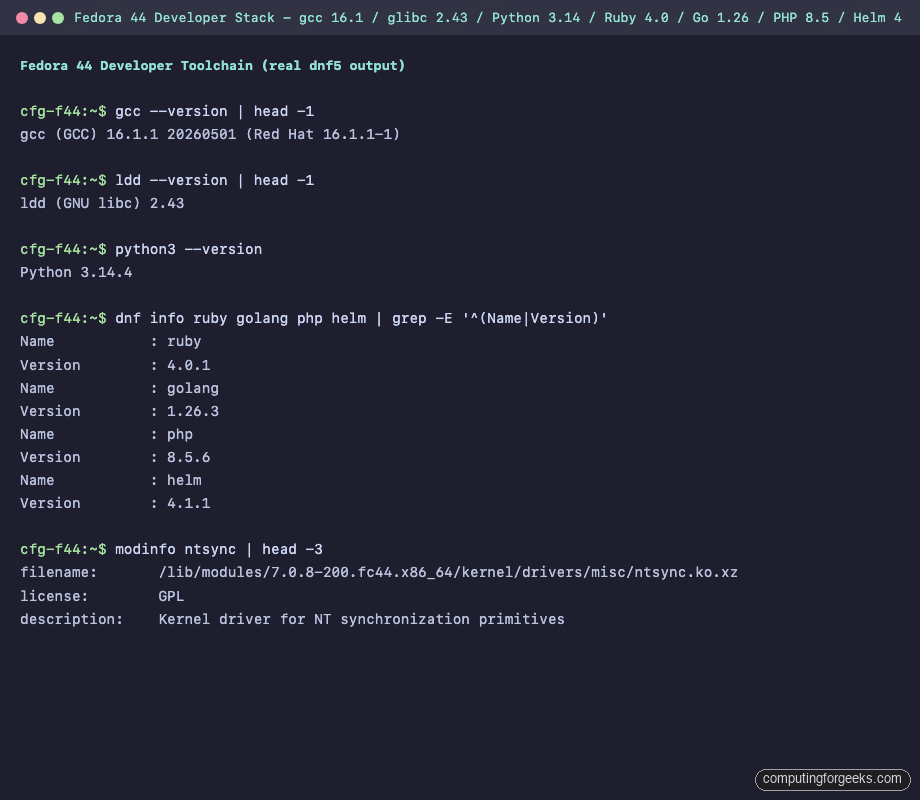
A few of the bumps have real consequences and are worth calling out:
- GCC 16.1: the new system compiler, with continued work on C++26 and C23 support. Stricter checks may surface latent bugs in long-lived C codebases.
- Ruby 4.0: the first major-version bump since 3.0 in 2020. YJIT is improved and Ruby 2.x-era deprecated features have been removed. Compatibility is the migration tax.
- Go 1.26: continued generics work, the
iterpackage and several long-experimental APIs become stable, and the linker is meaningfully faster on big projects. - PHP 8.5: covered in detail in our PHP 8.5 on Debian guide; on Fedora the version becomes the system default without module switching.
- Helm 4: the major-version Helm bump tidies up command UX defaults and ships parallel-installable as
helm3for the migration window. - CMake 4.0 with ninja default: the
%cmakeRPM macro now generates ninja projects by default, which materially speeds up package builds. Older CMakeLists.txt files that hardcodecmake_minimum_required(VERSION 3.x)need updates for CMake 4 compatibility. - Haskell GHC 9.10 + Stackage 24: moves with the upstream LTS series.
- Boost 1.90: a meaningful jump for anyone building C++ packages against the Fedora SDK.
- LLVM 22: all sub-projects (clang, lldb, mlir, polly) move together. Rust bindgen’s minimum is bumped to 0.72 to keep Rust packages building against the new LLVM.
- Ansible 13 (with ansible-core 2.20): includes the long-awaited Jinja2 templating engine fixes and a stricter inventory parser. Older playbooks that relied on lenient parsing may need touch-ups.
- Django 6.x: the default Django stack moves from 5.x to 6.x.
- uutils-coreutils 0.5 / nushell 0.109.2: the Rust-based command utilities continue to mature in parallel with the GNU originals.
For Node.js, Fedora 44 switches to a swappable -bin package pattern: /usr/bin/node and /usr/bin/npm are symlinks managed via nodejsXX-bin packages, which makes side-by-side Node 22 / Node 24 installs trivial. Containers users get Docker CE on Fedora as before; the install pulls dnf5-style metadata.
The package layer: PackageKit on libdnf5, DNF5 plugins, RPM 6 carried forward
This is the area where the headlines and the reality drift apart. The big platform pieces (DNF5 as the default dnf command, RPM 6.0 as the package format) landed in Fedora 43. Fedora 44 is the release that finishes the desktop integration: PackageKit is now built on top of libdnf5, which means GNOME Software, KDE Discover, and any other front end that uses PackageKit go through the same code path as dnf install on the terminal.
The output from a freshly upgraded Cloud image:
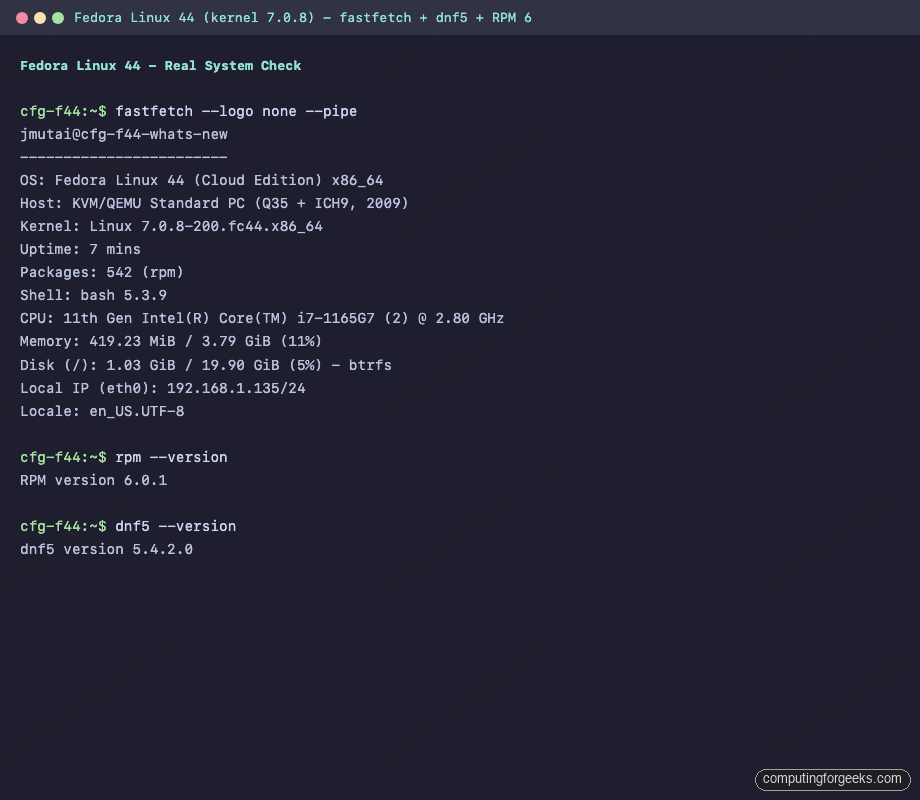
For backwards compatibility the legacy Python dnf-3 binary is still shipped, and python3-dnf is installable for tools that depend on the old plugin API. Use dnf5 for everything else.
Practical takeaway: if you were already on Fedora 43, your day-to-day CLI experience is unchanged. If you were on Fedora 42 or earlier, this is the upgrade where Software Center finally matches the speed of dnf5 in a terminal.
Kernel and init: 6.19 at GA, 7.0 on the update train, systemd 259, mkosi-initrd
Fedora 44 shipped with kernel 6.19 on April 28, 2026 and has already rolled forward to the 7.0 line through normal dnf updates. The 7.0 series pulls in a wider hardware support matrix for newer AMD and Intel laptops, the second wave of bcachefs fixes, expanded io_uring features, and (most relevant to F44) the in-tree NTSYNC driver covered above.
Two operational notes for anyone running Fedora in production or in a homelab cluster. First, the systemd in this release is 259, which keeps the recent systemd-tmpfiles hardening defaults and introduces a few sysext changes worth reading the changelog for if you build your own appliance images. Second, mkosi-initrd is now packaged as an alternative initrd builder with a kernel-install plugin. dracut is still the default, but mkosi-initrd is a viable path for minimal, signed, reproducible initrds if that matters for your workflow.
Server, cloud, and infrastructure
The server and cloud-side changes are quieter but matter for anyone running Fedora as a base for VMs, containers, or bare-metal infrastructure.
- MariaDB 11.8 is the new default, moving up from the long-running 10.11 LTS line. The community-mysql package names are gone; everything is just
mariadb-serverandmariadb. The MariaDB on Fedora install guide covers the new defaults end-to-end. - Fedora Cloud uses Btrfs for /boot (as a subvolume), eliminating the separate /boot partition and simplifying cloud-image growth and snapshotting.
- Anaconda no longer creates default network profiles for every device it sees. Only the interface used during install gets a profile, which is what most automation pipelines have been working around for years.
- OpenSSL ca-certificates layout was restructured with directory-hash support, and the legacy
cert.pemfile is no longer shipped. Tools that hardcoded that path need to be repointed at/etc/pki/tls/certs/. - Hardlink-identical-files is on by default during package build, which trims a few hundred MB off a typical install.
- Fedora CoreOS and bootc-based artifacts now build on Konflux instead of the legacy Jenkins pipeline.
- Packit is the new dist-git CI, replacing the older Fedora CI / Zuul setup.
- aarch64 Live ISOs auto-select the right device tree blob (DTB), which makes the images bootable on Windows on ARM laptops with no manual fiddling.
Nix in the official repos
Fedora 44 is the first Fedora release to package the Nix functional package manager. sudo dnf install nix gets you Nix 2.34 in a Fedora-policy build: the daemon ships as a normal systemd unit, and the build user pool is created at package install. You no longer have to run the upstream installer script and figure out SELinux contexts by hand.
For anyone who has been waiting for a sane way to layer Nix on top of an RPM-based system, this is it.
Removed and deprecated
A few packages and behaviors that previous Fedora releases shipped are gone in 44. None of these should surprise a regular user, but they are the kind of thing that breaks a CI pipeline or an automation playbook silently.
- java-21-openjdk is removed earlier than planned (was originally scheduled for Fedora 45). Use
java-25-openjdk(current LTS) orjava-21-openjdk-portableif you genuinely need 21. - QEMU 32-bit host builds are gone. You can still emulate 32-bit guests; you cannot run the qemu binaries on a 32-bit host.
- FUSE 2 libraries are dropped from the Atomic Desktops (Silverblue, Kinoite, Sericea, Onyx). Any FUSE 2 program needs a FUSE 3 update.
- pkla polkit rules are no longer honored on Atomic Desktops. Move to JavaScript polkit rules under
/etc/polkit-1/rules.d/. - LibreOffice’s KF5 integration package is gone. Plasma 6 is Qt6 and so is everything in the Fedora KDE stack now.
- python-mock is being removed across the distro; use the stdlib
unittest.mock. - community-mysql package names are retired. Anything that installed by that name should switch to
mariadb-serveror one of the newmariadb11.8-*versioned packages. - The standalone Fedora CI / Zuul integration is replaced by Packit-based Testing Farm.
- The
cert.pemcompatibility file is no longer shipped (the directory-hash layout is the canonical source now).
How to get Fedora 44
There are two clean paths to a Fedora 44 install. For a new machine or a fresh VM, our Fedora 44 step-by-step install guide walks through the Anaconda flow with real screenshots, partitioning choices, user setup, and first-boot fastfetch verification.
If you are already on Fedora 43, the Fedora 43 to 44 upgrade guide covers the supported dnf system-upgrade path with full version verification before and after.
Direct downloads live on getfedora.org for Workstation, spins.fedoraproject.org for KDE / Cinnamon / Sway / Xfce, and fedoraproject.org/cloud for the Cloud Base qcow2 used in this article’s testing.
The full ChangeSet for the curious is at the Fedora 44 ChangeSet wiki. The TL;DR for everyone else: this is the release where Fedora finished the X11 transition on the desktop (GDM is Wayland-only now), landed NTSYNC for gaming, brought PackageKit onto the libdnf5 stack that DNF5 already used, and quietly pulled the rest of the developer toolchain forward another generation. If you have been on Fedora 41 or 42, this is a worthwhile upgrade. If you are on Fedora 43, it is mostly a smooth dnf system-upgrade away.