Online shopping is no longer just a matter of choosing between a few products. Today, shoppers often have to compare prices, read reviews, look for promo codes, check sellers, track discounts, and understand whether a deal is actually worth it. As a result, more and more services are adding AI-powered features that handle part of this routine: finding products, analyzing purchase conditions, helping with coupons, visual search, virtual try-ons, and product comparisons.
Below is a selection of AI shopping services for different shopping scenarios. This is not a ranking, and these tools are not direct competitors: each one solves a different task.
1. AliHelper – an AI Assistant for Shopping on AliExpress
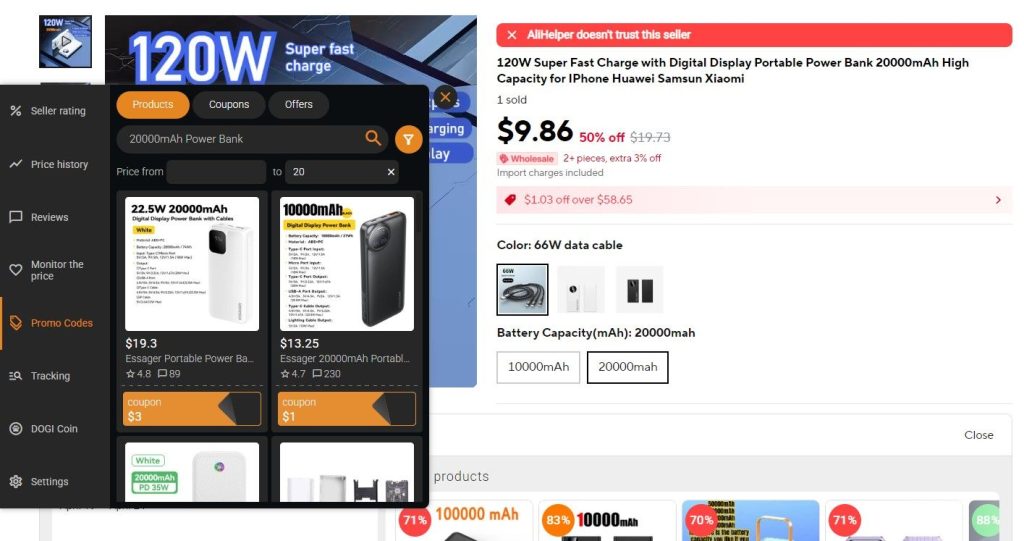
AliHelper is a free service for AliExpress users that helps find better deals, track prices, check seller ratings, and work with coupons. One of its notable AI use cases is helping shoppers find products with active coupons and additional discounts.
The challenge is that AliExpress coupons may be offered by different sellers, apply to different product categories, have minimum order requirements, and disappear quickly. Checking every store manually is inconvenient: you need to open seller pages, review coupon terms, check expiration dates, and understand whether a coupon can be applied to a specific product.
AliHelper’s AI models help simplify this process. The service collects coupons, classifies them by category, conditions, and discount type, and then shows users more relevant options. For example, instead of simply searching for “power bank,” users can look for products that already have active coupons. AliHelper can also take into account products added to Favorites and suggest similar offers with current discounts.
Best for:
shoppers who often buy on AliExpress and want to spend less time manually searching for promo codes, coupons, and deals.
How AI helps:
it does not simply show a general list of discounts; it helps connect coupons with specific products and user interests.
2. Amazon Rufus – a Product Question Assistant Inside Amazon
Amazon Rufus is an AI assistant within the Amazon ecosystem. Its purpose is to help shoppers understand products faster, ask clarifying questions, and make decisions without spending a long time reading dozens of listings and reviews. In practice, it works like an in-store consultant inside the marketplace: users can ask how one product differs from another, whether it suits a specific use case, or which features matter most in a category.
This format is especially useful when a shopper does not yet fully understand what kind of product they need, for example when choosing electronics, home goods, sports equipment, or gifts.
Best for:
shopping on Amazon when you need to quickly understand product features and compare options.
How AI helps:
it turns product pages and reviews into a clearer dialogue: the user asks a question in natural language and receives a structured answer.
3. Google Shopping and AI Mode – Finding Products in Natural Language
Google is expanding AI features in Search and Google Shopping. Instead of choosing precise keywords and manually adjusting filters, users can describe what they need in everyday language: for example, “a waterproof backpack for travel,” “a gift for a child who likes drawing,” or “a moisturizer for sensitive skin.”
AI Mode in Google Search can gather information about products, prices, reviews, and availability, as well as show comparisons and visual selections. Google is also developing agentic features, such as price tracking and purchasing after user confirmation in supported stores.
Best for:
the early search stage, when the user has not yet chosen a store and wants to explore options from different sources.
How AI helps:
it helps turn a general need into a concrete list of products, features, and purchase options.
4. Google Try-On – AI-Powered Clothing Try-On
Buying clothes is a separate shopping scenario. Price and size are not enough: shoppers also want to understand how an item may look on them. Google Try-On uses AI to let users upload an image and visually estimate how selected clothing may appear on them.
This does not replace size charts or real customer reviews, but it can reduce uncertainty before making a purchase. It is especially useful when choosing dresses, tops, trousers, and other items where appearance plays a major role. Google notes that AI visualization may be inaccurate and does not guarantee an exact fit, so it is better used as an additional reference point.
Best for:
online clothing shopping when you want to preview an outfit before buying.
How AI helps:
it allows users not only to read a product description, but also to visually evaluate the style.
5. Pinterest Visual Search – Finding Products Through Images and Inspiration
Pinterest has long been used as a platform for discovering ideas: interiors, outfits, gifts, décor, makeup, jewelry, and seasonal looks. Its AI-powered visual search features help users find similar items not through text, but through an image or a specific part of an image.
For example, a user may notice a beautiful lamp in an interior photo, a dress in a picture, or an unusual coffee table. Instead of trying to describe the item in words, they can select the object in the image and find similar options. Pinterest can also show similar or shoppable products from retailer websites.
Best for:
situations where a purchase starts not with an exact search query, but with a visual idea.
How AI helps:
it helps find a product even when the user does not know what it is called.
6. Klarna AI Assistant – Support for Shopping, Payments, and Customer Questions
Klarna is widely known as a fintech service for online payments, but the company is also developing an AI assistant for shopping. Its role is broader than simply helping users find a product: it can assist with the shopping experience, support, returns, order-related questions, and personalized recommendations.
This type of service is useful not at the “find a coupon” stage, but closer to the purchase and post-purchase experience: when a user needs to understand a payment, return, order status, or purchase terms.
Best for:
users who shop through stores and services connected to Klarna and want to resolve questions about payments and orders faster.
How AI helps:
it reduces manual steps and helps users get answers about purchases more quickly.
7. ChatGPT Shopping Research – Purchase Research Before Choosing a Product
ChatGPT Shopping Research is useful when a user describes a task, budget, limitations, and preferences, and AI helps prepare a product selection and comparison. This format is especially convenient for more complex purchases: electronics, home goods, gifts, sports equipment, cosmetics, or appliances.
Instead of opening many tabs and comparing specifications manually, users can describe their situation: “I need a quiet cordless vacuum cleaner for a small apartment,” “suggest a gift for a 4-year-old child,” or “compare these three models.” AI can then ask clarifying questions and create a more structured buyer’s guide.
Best for:
the research stage, when the user is not ready to buy yet and first wants to understand which options are worth considering.
How AI helps:
it turns chaotic searching into a clear comparison with pros, cons, and selection criteria.
How to Choose an AI Shopping Service
There is no single universal tool for every purchase yet. It is better to choose a service based on the specific task:
- if you shop on AliExpress and want to find coupons, AliHelper may be useful;
- if you are shopping inside Amazon, Amazon Rufus can help;
- if you want to find products from different stores, Google Shopping and AI Mode can be useful;
- if visual clothing try-on matters, Google Try-On is worth considering;
- if your purchase starts with an image or an idea, Pinterest Visual Search may help;
- if your question is related to payment, an order, or a return, Klarna AI Assistant can be relevant;
- if you need to compare options in depth before buying, ChatGPT Shopping Research can help.
The main value of AI in shopping is not that it “buys instead of the user,” but that it shortens the path from intention to informed choice. Artificial intelligence helps users understand options faster, remember discounts, review conditions, compare products, and avoid unnecessary routine.
At the same time, it is important to remember that AI services support decision-making but do not replace the shopper’s own attention. Before paying, it is still worth checking the final price, delivery terms, seller rating, return conditions, and whether the discount is still valid. In that case, AI becomes not just a trendy feature, but a practical tool for more convenient and efficient online shopping.