


In today’s modern society, communication is the first step to mutual understanding and co-existence of clashing personalities, cultures, and beliefs. However, languages are still a very real barrier, leading to misunderstandings and misconstrued intentions. Thankfully, with the recent advancements in artificial intelligence, especially in the areas of real-time translation and speech recognition, these linguistic challenges are starting to get addressed, reshaping the way we communicate with each other.
How useful is AI in translating?
The traditional process of translating text from one language to another is time-consuming and often expensive – you probably won’t find a professional translator who really knows what they’re doing and is willing to work for free. With the introduction of AI technology, however, we’ve received access to a range of real-time translation tools that have revolutionized this process.
Today, we have access to a wide range of services like Google Translate, Microsoft’s Translator, and other systems that have incorporated AI to provide accurate and instant translations for numerous languages. Apps like CapCut even use AI algorithms to intelligently convert speech-to-text, creating automatic captions in a fraction of time it would take to do by hand.
AI-powered translators have many advantages over human translators – the combination of powerful machine learning algorithms and access to vast databases of language data give them the ability to produce quick and accurate translations much more efficiently than humans could. These programs can work round-the-clock and process huge volumes of information without getting tired, providing translations at unmatchable speeds.
Speech recognition and AI
Translating written words is one thing, but AI can also be used to translate speech in real-time by utilizing speech recognition technology. You’ve definitely heard of virtual assistants like Alexa or Google Assistant that use speech recognition to understand voice commands – thanks to AI algorithms, these assistants can better understand the context of commands, and can understand orders without them having to stay strict to syntax.
The combination of automatic speech recognition, natural language understanding, and text-to-speech technologies create a unified system that is capable of understanding and responding to verbal commands in many different languages.
One of the latest innovations in AI translation is Neural Machine Translation – NMT for short. It’s a novel approach that utilizes deep learning algorithms to train a large neural network to predict the likelihood of a sequence of words, promising many improvements over traditional machine translation. Instead of looking for keywords in a sentence, these systems can understand the full context and generate more fluent, natural-sounding translations. With NMT, the translation process is smooth, and its results have more nuances, capturing many subtleties that would have otherwise been lost in translation.
What else can AI be used for?
AI technology is a huge game-changer for a wide range of industries, revolutionizing not only speech recognition and translation, but also healthcare, retail, and many other fields. AI can help in medical diagnostics to predict diseases and help doctors diagnose illnesses quicker and more accurately. It can also automate many administrative tasks, which have always been the biggest hurdle for healthcare systems.
Artificial intelligence is also what’s powering self-driving cars that are becoming more and more prominent. AI systems can sense the environment and recognize objects, helping vehicles make intelligent decisions and controlling the vehicle. Even though still not implemented on a large scale, this technology has a huge potential to innovate transportation.
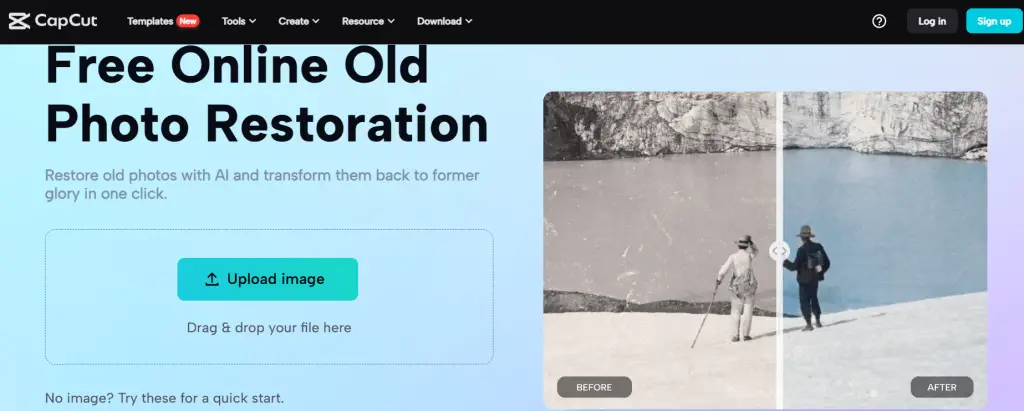
Online video editors like CapCut make use of AI algorithms to make post-processing of images and photos simple and easy. CapCut allows users to perform old photo restoration, bringing back damaged pictures to life, and even have the AI color-correct the image automatically to improve the quality. Simply upload your media, choose how you want to enhance it, and let the AI do its thing – no need to become a professional editor to perform high-quality post-processing anymore!
Closing remarks: what is the future of AI in translation?
AI translation and speech recognition systems are not without limitations, even though they can be extremely useful. Accuracy, particularly in complex or specialized contexts, is still a significant concern, and many less-popular languages still lack extensive support. As AI systems continue to improve, these problems will become less and less severe, as the translations become more accurate and available in a wider variety of languages.
The world is changing as we speak, with artificial intelligence helping us minimize mundane work and automate many processes. One day, perhaps, it will allow us to create a society where language is no longer a barrier, and we’ll all be able to reach for accurate real-time translation at any time. Still, this creates new concerns – mainly about data security, since AI systems learn from the data inputted into them. How will world governments deal with these issues? Only time will tell.
