Every dev team carries a hidden workload that never shows up on the sprint board: the manual ticket updates after a PR merges, the Slack message nobody sent, the task still marked In Progress three days after it shipped. None of it is hard work. All of it takes time. And in fast-moving DevOps environments, that overhead compounds.
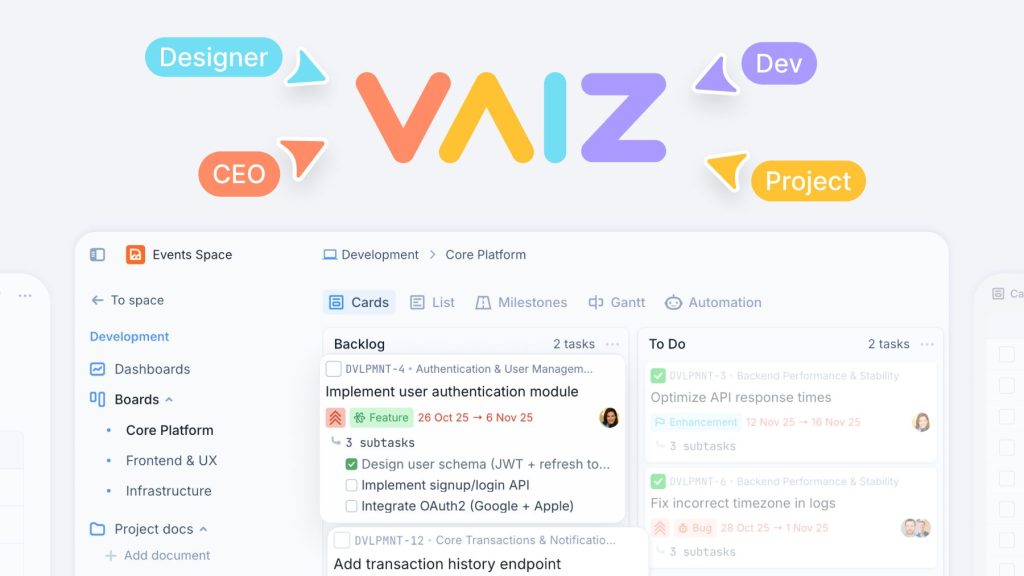
Vaiz approaches automated project management as a core part of the platform rather than a bolt-on feature. Teams build event-driven automation rules directly inside the workspace: when a task is created, assign it to the on-call engineer; when a status moves to Review, notify the tech lead in Slack; when a due date passes without a status change, escalate automatically. No external automation tool required, no YAML to maintain.
The GitHub and GitLab integrations are where the automation pays off most visibly for development teams. When a developer opens a pull request, creates a branch, or merges code, Vaiz automatically updates the linked task — status, assignee, timestamps — without anyone touching the ticket. Sprint boards stay accurate in real time. Standups stop being a status collection exercise and start being an actual decision meeting.
For teams that need to go further, Vaiz exposes a REST API, a Python SDK, and webhook support for pushing task events into external pipelines — CI/CD systems, monitoring tools, custom dashboards. Through Zapier, Vaiz connects to 9,000+ app integrations without writing code, covering everything from incident management tools to cloud infrastructure platforms. Teams can also embed Swagger and GraphQL documentation, Mermaid diagrams, Figma designs, and CodeSandbox environments directly inside tasks — keeping technical context alongside the work rather than scattered across browser tabs.
Vaiz supports the Model Context Protocol (MCP), which allows AI coding tools like Cursor and Claude Desktop to securely read from and write into the workspace. For teams already using AI-assisted development, this means task creation, status queries, and project context are available inside the tools where the actual coding happens — without switching to a browser tab or manually copying ticket details.
One problem automation alone cannot solve is context fragmentation — when the spec sits in a wiki, the ticket sits in a tracker, and neither knows about the other. Vaiz keeps both in the same record: each task has a built-in rich editor where teams write specs, architecture notes, and acceptance criteria directly alongside the work item. Automation rules operate on these fully-contextual tasks, so triggers and the information they act on always live in the same place.
Vaiz ships pre-built templates for Scrum, Kanban, and OKR-based planning. For teams moving off another tool, the Migration Center handles one-click imports from Jira, Asana, Linear, Trello, and YouTrack — transferring tasks, subtasks, comments, attachments, and assignees without manual reconstruction.
The platform is free for teams of up to 10 users with no time limit. Engineering teams that scale beyond that pay $5 per user per month on the Pro plan or $9 per user per month on Premium, billed annually. Startups qualify for a 50% discount. Every paid plan includes a 30-day trial with no credit card required.
Vaiz holds a 4.9/5 rating on G2 and Crozdesk. Technical teams using the platform include Oqtima, ATOM Global, and Blockchain Sports.
Teams can explore the platform or start a free workspace at vaiz.com.